


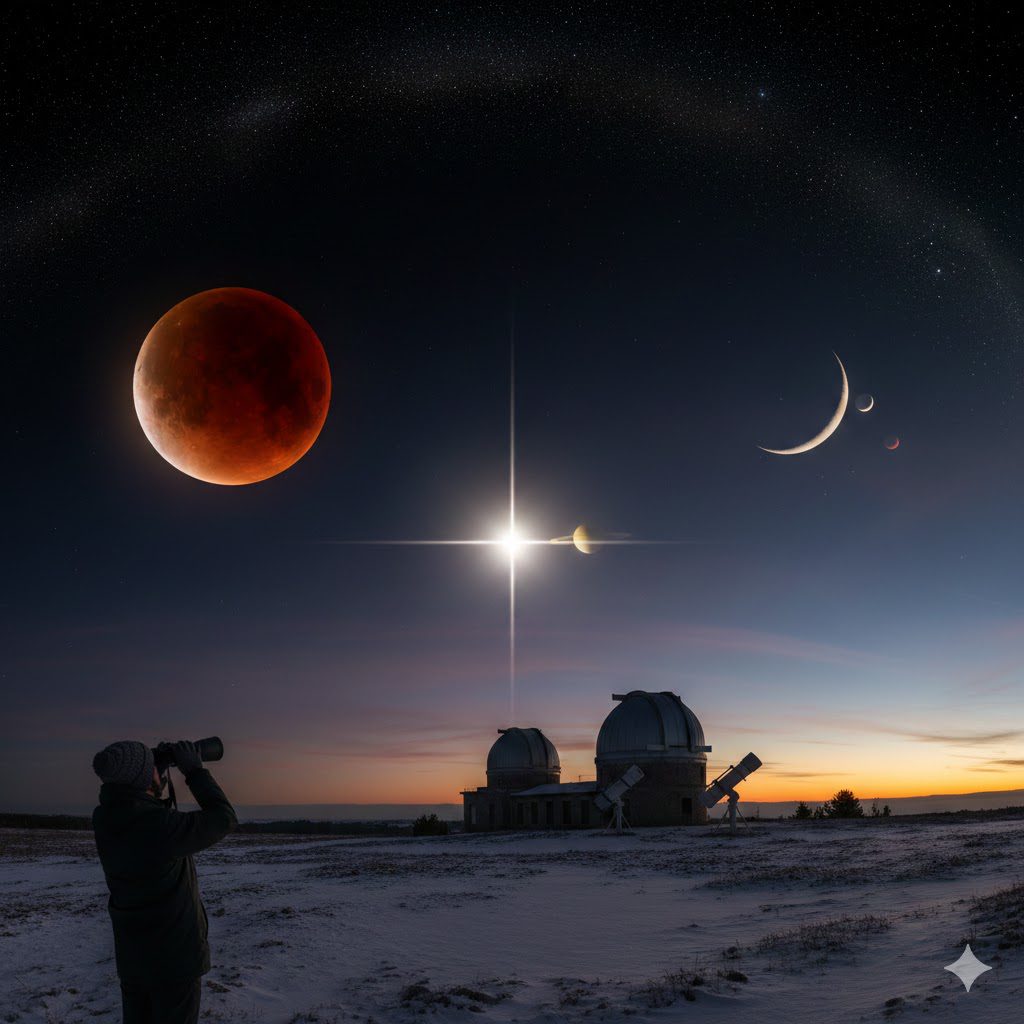
March 2026 Astronomy Guide: A Planetary Double-Feature
March 2026 is shaping up to be a playground for amateur astronomers and casual stargazers alike. While the month is anchored by the Vernal Equinox on March 20, the real drama unfolds in the margins of the day: the golden hour after sunset and the quiet chill of pre-dawn. Two specific events—a rare meeting of Venus and Saturn and a triple-alignment involving the Moon—offer a perfect reason to step outside and look up.
Table of Contents
1. The Evening Glow: Venus Meets Saturn (March 8)
On the evening of March 8, 2026, the western sky will host a beautiful “kiss” between two of the most distinct planets in our solar system. Venus and Saturn will come into conjunction, appearing only about 1° apart. For reference, that is roughly the width of your pinky finger held at arm’s length against the sky.
What to Expect
-
Contrast in Brightness: This event is a study in extremes. Venus will be blazing at a magnitude of -3.9, making it the brightest object in the sky after the Sun and Moon. Saturn, meanwhile, will be much subtler at magnitude 1.0.
-
The Visual: Venus will look like a steady, brilliant white diamond, while Saturn will appear as a smaller, yellowish-gold spark sitting just beside it.
Observation Strategy
The “Golden Window” for this event is quite short. You should begin your search near the western horizon within 60 minutes after sunset. Because the planets are low in the sky, you will need a viewing spot with a clear horizon—avoid areas with tall buildings or dense treelines.
While this is perfectly visible to the naked eye, binoculars will help you pick out Saturn’s steadier glow against the lingering twilight. In the Northern Hemisphere, particularly in mid-latitude and subtropical regions, the pair will be easy to find in the southwestern quadrant. Southern Hemisphere observers will find them slightly lower and further west.
2. The Pre-Dawn Trio: Moon, Mars, and Mercury (March 18)
If you are an early bird, the morning of March 18 offers a rare “triple performance.” Low in the southeastern sky, a razor-thin crescent Moon (only 2% illumination) will nestle between Mars (magnitude 1.1) and Mercury (magnitude 1.6).
The Challenge of the Inner Planets
This event is a “trophy” for stargazers because Mercury is notoriously difficult to spot. It stays close to the Sun, often lost in its glare. However, on this morning, the Moon acts as a celestial roadmap, leading your eyes directly to the two faint planets. The three bodies will be clustered within a tight 1–2 degree radius.
Observation Strategy
Timing is everything for this pre-dawn show. You have a narrow 60-minute window before sunrise to catch them.
-
Sky Conditions: You need excellent conditions—low humidity, no clouds, and minimal light pollution.
-
Hemisphere Advantage: This event heavily favors the Southern Hemisphere. From that vantage point, the trio rises higher in the sky before the sun breaks the horizon, giving you more time to observe.
-
Northern Hemisphere Tips: For those in the North, look toward the southeast just before astronomical dawn begins. You will need a completely unobstructed view of the horizon, as the trio will be hugging the earth.
3. The Worm Moon & Total Lunar Eclipse (March 3)
Earlier in the month, a truly rare visual feast occurs. The full moon of March, often called the Worm Moon, will coincide with a total lunar eclipse. During this time, the Moon will pass into Earth’s shadow, taking on a deep, reddish-brown hue—a phenomenon often called a “Blood Moon.” This will be visible across much of Europe, Asia, Australia, and the Americas.
4. Stargazing Preparation & Essential Tips
To make the most of these events, consider these preparation pillars:
-
Find Darkness: Use a light pollution map to find a “Green” or “Blue” zone near you. For the March 18 triple-alignment, dark skies are not just a luxury; they are a necessity to see Mercury’s faint light.
-
Weather Awareness: March is a transitional month. High-pressure systems often bring the clear, crisp air needed for planetary viewing, but they also bring cold nights. Dress in layers and bring a warm beverage.
-
Optics: While these are naked-eye events, a small astronomical telescope can reveal the phase of Venus (which will look like a tiny, bright gibbous moon) or the slight reddish hue of Mars